domenica 28 settembre 2008

§6 - HAITIAN VOODOO INFO

Ancient Traditions

Voodoo, meaning "spirit", may be one of the world's oldest ancestral, nature-honoring traditions, according to Mamaissii Vivian Dansi Hounon, a member of OATH, the Organization of African Traditional Healers in Martinez, Georgia.

Some anthropologists estimate that voodoo's roots in Benin—formerly Dahomey—West Africa may go back 6,000 years. Today an estimated 60 million people practice voodoo worldwide.

At a voodoo ceremony, believers gather outdoors to make contact with the Loa, or spirit, any of a pantheon of spirits who have various functions running the universe, much like Greek gods. There is also a responsibility to care for beloved and deified family spirits and to honor a chief god, Bondieu.


Messages From the Spirits

During the ceremony, the houngan or mambopriest or priestess— sacrifices a sanctified chicken or other animal to the Loa. Participants then ask the spirits for advice or help with problems. More than half the requests are for health.

It is said that the Loa sometimes communicate prophecies, advice, or warnings while the believer is possessed. Other messages are sent through the priest or priestess, or sometimes come later in dreams.

These disembodied spirits are believed to become tired and worn down—and rely on humans to "feed" them in periodic rituals, including sacrifices. "It's not the killing of the animals that matters," Corbett said. "It's the transfer of life energy back to the Loa."

Each of the spirits has a distinct identity. Some are loving and good, while others are capricious or demanding. Haitians believe that the Loa most often express their displeasure by making people sick.

Black Magic?


In the West voodoo has been portrayed in zombie movies and popular books as dark and evil, a cult of devil worship dominated by black magic, human sacrifice, and pin-stuck voodoo dolls—none of which exist in the voodoo practices that originated in Benin.

In Haiti voodoo began as an underground activity. During the 1700s thousands of West African slaves were shipped to Haiti to work on French plantations.

The slaves were baptized as Roman Catholics upon their arrival in the West Indies. Their traditional African religious practices were viewed as a threat to the colonial system and were forbidden. Practitioners were imprisoned, whipped, or hung.

But the slaves continued to practice in secret while attending masses. What emerged was a religion that the colonialists thought was Catholicism—but they were outfoxed.

Hybrid Rituals

It was easy to meld the two faiths, because there are many similarities between Roman Catholicism and voodoo, Corbett said. Both venerate a supreme being and believe in the existence of invisible evil spirits or demons and in an afterlife.

Each religion also focuses its ceremonies around a center point—an altar in Catholicism, a pole or tree in voodoo. Their services include symbolic or actual rituals of sacrifice and consumption of flesh and blood, Corbett noted.

Many of the Loa resemble Christian saints, endowed with similar responsibilities or attributes. For example, Legba, an old man, is said to open the gates between Earth and the world of the Loa, much like St. Peter traditionally throws wide the gates to heaven.

But there are differences. Westerners tend to believe in free will and personal choice. Not so in voodoo.

"The Haitian people have a view of the world that is unimaginably different from ours," Corbett said. The Loa are believed to determine our lives to an astonishing degree, he explains, and they are always present in great numbers: There might be two people in a room, but there are also 20 Loa.

"Our view is dominated by physical, touchable reality. In Haiti the spirits are as real as your wife or your dog," Corbett said.

Like any other religious practice, voodoo brings great benefits, explains Warberg, the photographer. "Participation in voodoo ritual reaffirms one's relationships with ancestors, personal history, community relationships—and the cosmos. Voodoo is a way of life," she said.

Ceremony

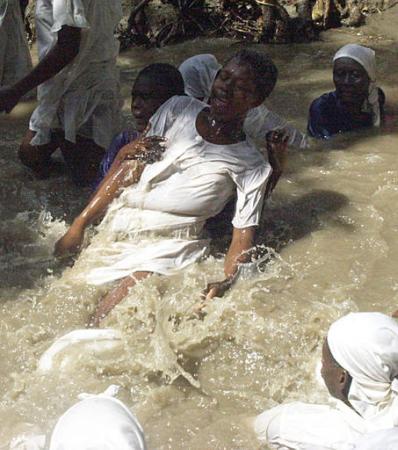
The ceremony begins with a Roman Catholic prayer. Then three drummers begin to play syncopated rhythms. The attendees begin to dance around a tree in the center of the yard, moving faster and harder with the rising pulse of the beat. The priest draws sacred symbols in the dust with cornmeal, and rum is poured on the ground to honor the spirits.

One woman falls to the ground, convulsing for a moment before she is helped back to her feet. She resumes the dance, moving differently now, and continues dancing for hours. It is perhaps no longer she who is dancing: She is in a trance, apparently possessed by Erzuli, the great mother spirit.

It is an honor to be entered and "ridden" by a Loa, or spirit. In Haiti these rituals are commonplace: Voodoo is the dominant religion.

"One common saying is that Haitians are 70 percent Catholic, 30 percent Protestant, and 100 percent voodoo," said Lynne Warberg, a photographer who has documented Haitian voodoo for over a decade.

In April 2003 an executive decree by then president Jean-Bertrand Aristide sanctioned voodoo as an officially recognized religion.

"It is a religion in the same way Judaism or Christianity is," said Bob Corbett, professor emeritus of philosophy at Webster University in St. Louis, Missouri. "Voodoo doesn't have a sacred text, a church, or a hierarchical structure of leaders, but it is very similar culturally."

martedì 23 settembre 2008

§5 - PÉTIONVILLE


Pétionville
Pétionville is a suburb of Port-au-Prince, Haiti, in the hills east and separate of the city itself on thee northern hills of the Massif de la Selle. It was named after Alexandre Sabès Pétion (1770 - 1818), the Haitian patriot/general and later president. The suburb is part of Port-au-Prince, yet its distance and local administration usually leads to its mention separate from the city itself. The district is primarily a residential and tourist area. Pétionville is one of the most affluent areas in the capital where the majority of tourist activity takes place and one of the wealthiest parts of the country. Many diplomats, foreign businessman, as well as a large number of wealthy citizens do business and reside within Petionville.


Video da youtube:

tragitto in auto da Port-au-Price (centro) a Pétionville
http://www.youtube.com/watch?v=x0HcUrhXehY

Nuovo Mercato a Pétionville
http://www.youtube.com/watch?v=ccEXuK0qlqo


Nightlife in Pétionville

Petionville is the wealthier part of Haiti where many mulattoes and very wealthy Haitians live. Places like Laboule and Morne Calvaire are known for their Palace-like Houses. The residents of Petionville live in affluence compared to their counterparts in many other parts of the country. Petionville is far more secure than the center of Port-au-Prince and in general, the other major cities of Haiti. The community is very stable with nightlife and business proceeding with an air of normalcy that greatly contrasts to many other parts of Port-au-Prince. The hillside neighborhood contains many bars, clubs, hotels, and restaurants. The famous hotel 'El Rancho' is situated in Petionville. Businesses that cater to tourists are commonplace, and parties and get-togethers often take place at night. Establishments often host considerable expatriates and foreigners of a similar caliber.


Information from Wikipedia

§4 - POLITICAL INFO


Colombo sbarca ad Hispaniola (Haiti-SantoDomingo)


Political Structure

Haiti is a presidential republic with an elected president and National Assembly. There have been, however, claims that the government is authoritarian in practice. On February 29, 2004, a rebellion culminated in the resignation of president Jean-Bertrand Aristide. The current interim president is Boniface Alexandre. The constitution was introduced in 1987, modeled on those of the United States and France, and was fully instated in 1994. The president is the head of state and elected by popular vote for five-year terms. He is assisted by his cabinet, which need the approval of the National Assembly. The prime minister, the head of government, is appointed by the president and ratified by the National Assembly. The bicameral National Assembly (Assemblee Nationale) is made up by Chamber of Deputies (Chambre des Députés) and the Senate (Sénat). The Chamber of Deputies has 83 members, which are elected for four-year terms. The Senate consists of 27 seats, one third elected every two years. Since the overthrow of the government in February 2004, the Senate is not sitting. The interim government does not recognize the remaining Senators. The legal system is based on the Roman civil law system. Haiti accepts compulsory jurisdiction of the International Court of Justice. There is a Supreme Court (Cour de Cassation), along with the assistance of local and civil courts at a communal level.

Prominent Figures Central Bank Governor: Raymond Magloire
Interim President: Boniface Alexandre
Interim Prime Minister: Gérard Latortue


Unique Characteristics

Haiti, located on the western end of the island Hispanola, has been a frequent victim to natural disaster. The long-term effects of natural disasters on Haiti have been substantial. The focus of production in Haiti has shifted from economic to environmental goals. Not only does Haiti's geographic location make it more prone to natural disaster, but also Haiti's deforestation and erosion caused by agricultural production has made Haiti it more susceptible to the adverse effects of natural disasters.

Key Economic Factors Economic Overview: The life of the Haitian economy is dependent on nation donors. Haiti is the poorest country in the Western Hemisphere where around 80% of the population lives in poverty. In May of 2000, almost all aid from the U.S. and E.U. ceased. With this deprivation, the Haitian economy has shrunk for the 4 years ensuing the stoppage. Together with inflation, lack of investment, a severe trade deficit, Haiti's economy has taken a toll. As of early 2005, aid has resumed from other nations but their economic problems have failed to go away. Tropical Storm Jeanne in Northwestern Haiti in 2004 further impoverished Haiti.
a slum near Port-au-Prince

Agriculture (*): Agriculture makes up 32% of Haiti's total gross domestic product. Its productivity has been profoundly affected by the adverse effects of Tropical Storm Jeanne. Haiti's primary agricultural products include coffee, mangoes, sugar cane, rice, maize, sorghum and wood.

Industries: The different industries Haiti is involved in include sugar refining, flour milling, textiles, cement, tourism, and light assembly.

Imports: Haiti's principle imports are food, machinery and transport equipment, and fuels.

Exports: Haiti's principle exports include coffee, mangoes, and oils.

Trading Partners: Haiti's biggest trading partners are the U.S. and E.U. with 86% percent of their exports going to the U.S. and 11% going to the E.U. Haiti imports 60% of their imports from the U.S. and 12% from the E.U.

________________________________________
(*) .... da Il Villaggio Globale (settembre 2008)

Il caso di Haiti

Partiamo da una delle nazioni più povere dell'emisfero occidentale. L'isola di Haiti risente di una lunga storia di cattiva gestione del territorio che risale ai tempi dell'approdo di Colombo nelle terre americane. Se nel 1923 le foreste coprivano il 60% del Paese oggi sono solo il 2-3%. La deforestazione ha intensificato l'erosione del suolo che, in un ciclo di reazione a catena, ha causato la diminuzione della resa agricola e prodotto gravi frane in tutta Haiti. Tra il 1991 e il 2002 la produzione alimentare pro capite è scesa del 30%. La mancanza quasi totale di copertura arborea ha fatto sì che ogni fenomeno atmosferico di una certa entità (non solo uragani) è causa di effetti rovinosi su tutta l'isola. Come dicono gli scienziati del settore «quando il suolo di una nazione va in rovina, così va anche la nazione». Se, infatti, gli haitiani avessero avuto una maggior produzione agricola locale, non sarebbero stati così vulnerabili ai prezzi del cibo importato.

lunedì 22 settembre 2008

§3 - HAITIAN GOURDE

The Haitian Gourde is the currency in Haiti (HT, HTI).
The symbol for HTG can be written G.

Le mot "gourde" est une traduction du mot espagnol "gordo" (gros, gras), un terme qui se referait au peso,

The Haitian Gourde is divided into 100 centimes.
from The exchange rate for the Haitian Gourde was last updated on September 15, 2008Bloomberg
100 HTG >> 2.58 US$ ---- 100 HTG >> 1.76 EUR
1 US$ >> 39.50 HTG ---- 1 EUR >> 56.85 HTG


Cross Rate Update > http://www.lematinhaiti.com/


The gourde was formerly pegged to the US dollar at a rate of 5 gourdes to one US dollar.
Since then, however, the gourde has been placed on a floating rate.
In light of the former peg, five gourdes are often referred to as a "Haitian dollar."
Five centimes, in similar nature, is referred to as a "Haitian penny."
In select regions of Haiti, prices are denoted in Haitian dollars rather than gourdes and customers are left to multiply the dollars by five.

Haitian gourde
gourde haïtienne (French)
goud ayisyen (Haitian Creole)
Five hundred Haitian gourdes


for other specimen of Haitian bills

http://www.brh.net/bils.htm


Inflation 9%
Source The World Factbook, 2007 est.


Symbol


G


Coins

Freq. used 50 centimes, 1, 5 gourdes
Rarely used 5, 10, 20 centimes


Banknotes

Freq. used 10, 25, 50, 100, 250, 500, 1000 gourdes
Rarely used 1, 2, 5 gourdes


TAUX DE LA GOURDE

09 oct 08

Le dollar américain s'achète à
38.75 Gdes
et se revend à
40.25 Gdes

§2 - INFO TELEFONO


Telephones (Haiti country code: 509)


Despite low literacy levels (52%) and wide-ranging poverty, Haiti managed to increase its cell phone coverage rate from 6% to 30% in just one year (May 2006 to May 2007). Haiti is now the driving force in the cell phone growth rate in the Caribbean. Radio still remains the primary information medium for most Haitians.
un venditore ambulante di ricariche telefoniche

Telephones - mobile cellular: 2.4 million (May 2007) or 30% coverage rate.

There are three major cell phone providers in Haiti: Digicel, Comcel, and Haitel.

Comcel (Voilà), a subsidiary of Trilogy International Partners, LLC, was a TDMA company which launched its service in September 1999.


Haitel, an independent company founded by Franck Ciné, a Haitian-American and former MCI/Worldcom executive, adopted CDMA technology.

Digicel Haiti, an affiliate of the pan-Caribbean Digicel Group won Haiti's first GSM license in June 2005 and launched service in early 2006


WIND ha accordo roaming con Digicel, Haiti


DATI OPERATORE
Display Digicel
Frequenza GSM 1800
Copertura http://www.gsmworld.com/roaming/gsminfo/cou_ht.shtml
Numeri di emergenza locali 112; 911
Customer Care +1 876 380 7626
Sito Operatore http://www.digicelgroup.com

DISPONIBILITA' SERVIZI VOCE E DATI


*124* disponibile
Roaming diretto disponibile
SMS disponibile


Se non e' disponibile il roaming diretto con Wind da Haiti, allora si puo' provare

Roaming *124*


Wind è con te ovunque! Se hai una carta ricaricabile e il servizio di roaming diretto non è disponibile, Wind chiama per te!
Componi il codice *124* seguito dal numero che vuoi chiamare comprensivo di prefisso internazionale e dal tasto cancelletto.
Premi invio e resta in attesa senza riagganciare: Wind ti richiamerà mettendoti in comunicazione con il numero desiderato.
Basta rispondere e sei subito in linea.

Per chiamare un numero di rete fissa ad esempio un numero di Roma, digita *124*+3906123...#invio.
Se invece vuoi chiamare un cellulare, ad esempio un numero Wind, digita *124*+39328123456#invio.


Attenzione alle tariffe WIND !!!


Costo delle chiamate effettuate

da zona 4 (Haiti)
---> a zona UE 4 euro min (e viceversa)

Costo delle chiamate ricevute
da zona UE ---> a zona 4 (Haiti) 2 euro min

Spedire un SMS
da zona 4 (Haiti) ---> a zona UE 1 euro

Ricevere SMS è gratuito


VOIP Providers


In May 2006, Comcel and Haitel had a total of about 500,000 subscribers - that is a cell phone coverage rate of 6% for a population of 8.2 million.

Then, Digicel entered the market in May 2006, and revolutionized the cell phone industry with low prices and attractive services so that after just one year of operations, May 2006-May 2007, Digicel went from zero to 1.4 millions subscribers.

The other two cell phone providers, Comcel and Haitel, responded by cutting their prices and offering new services such as Voila, a GSM service by Comcel, and CDMA 2000 by Haitel. As a result, Comcel and Haitel increased their subscribers from 500,000 to 1 million. That's a grand total of 2.4 millions cell phone subscribers in Haiti. For a total population of about 8.2 million people, that's a cell phone coverage rate of 30% (a 5-fold increase in just one year).

In May 2007, Digicel started offering two Blackberry services with Internet, one for enterprises and one for individuals.


Telephones - main lines in use: 115,060 (2005)

Télécommunications d'Haiti S.A.M. (Teleco), a 98%-government owned company, has a monopoly on the provision of landline services throughout the country. Teleco has been constantly hobbled by political interference which has affected its performance.
Teleco is currently undergoing privatization.

Telephone system:

Domestic facilities are barely adequate.

International facilities are slightly better
domestic: coaxial cable and microwave radio relay trunk service
international: satellite earth station - 1 Intelsat (Atlantic Ocean)


APPENDIX


Dual, Tri, or Quad Band GSM Phone?

Quad band GSM are becoming more common and less expensive.

Increasingly, a quad band phone should be your first choice of phone.


Two frequency bands are used by GSM services in the US. Two different frequency bands are used by GSM services elsewhere in the world.

Ideally, you'd want a phone that can work on all four bands - commonly called a quad-band phone. But these are still rare and expensive

GSM cell phones use frequencies within four different frequency bands :

  • 850 MHz (824.2 - 848.8 MHz Tx; 869.2 - 893.8 MHz Rx)

  • 900 MHz (880-2 - 914.8 MHz Tx; 925.2 - 959.8 MHz Rx)

  • 1800 MHz (1710.2 - 1784.8 MHz Tx; 1805.2 - 1879.8 MHz Rx)

  • 1900 MHz (1850.2 - 1909.8 MHz Tx; 1930.2 - 1989.8 MHz Rx)

Although 850 and 900, and 1800 and 1900 are very close together, a phone that works in one frequency band unfortunately can not also work in the frequency band next to it unless added as a specific extra frequency band.

What about 800 MHz? Is this a fifth band?

Some people refer to the 850 MHz band as being the 800 MHz band. This is incorrect. The actual frequencies in the band are closer to 850 MHz and the standardized naming convention as promulgated by the GSM Association is to refer to this band as '850 MHz'.
If you see someone referring to a phone with 800 MHz service, they probably are simply mistaken and mean to refer to the 850 MHz band.


Which frequencies are used internationally?

GSM was originally developed in Europe, and only came to the US recently.
Initially, all countries with GSM service used the 900 MHz band. In the past few years, service providers have increasingly been adding 1800 MHz coverage, due to congestion in the 900 MHz band.

When the US started to use GSM, a few other countries with very close links to the US chose to copy the US and use the same frequencies that the US used - first 1900 MHz, and in a few cases, 850 MHz also.

Almost without exception, all international countries that use the non-US international frequency bands have 900 MHz service, and many have some 1800 MHz service as well.

All international countries that have the US frequency bands have 1900 MHz service. A very few might also have some 850 MHz service.


Which frequencies do you need when traveling internationally?

Refer to the table below to get a feeling for which countries use which frequency bands. For a more expanded set of information, complete with network coverage maps, refer to the official GSM Association's website.


Quad band phones: Motorola V3 Razr (but not V300)

V180 (note - some people report that Cingular
disables the 1800MHz band, but in theory
these phones should have four bands)

V220

V330

V400

V500 / V501 / V505 / V525 / V551 / V555

V600 / V620


NB All tri-band phones obviously (?) support three different frequency bands. But they may differ in their choice of which three of the four bands they support.

The two common variations are :

900/1800/1900 - Excellent internationally and very good in the US

850/1800/1900 - Excellent in the US but not very good internationally


A look ahead - five and six band phones?

Phones that support new high speed data services - so called '3G' (as in 'third generation') phones will generally have the high speed data service on yet another band; typically 2100 MHz.

The market for high speed data services is currently still evolving, with several different technologies, each incompatible with each other, being offered by different service providers. We'll comment more on 3G issues when things stabilize into a clearer picture.


Frequency Bands by Country

(Looking for a country not on this list? Ask, and we'll add it.)

Country

900

1800

1900

850

Afghanistan


Albania


Algeria


Angola


Anguilla


Antigua & Barbuda


Argentina


Armenia


Aruba


Australia


Azerbaijan


Austria


Bahamas


Bahrain


Bangladesh


Barbados


Belarus


Belgium


Belize


Benin


Bermuda


Bolivia


Bosnia & Herzegovina


Botswana


Brazil


British Virgin Islands


Bulgaria


Burma/Myanmar - 900 planned


Cambodia


Cameroon


Canada


Cayman Islands


Chad


Chile


China


Colombia


Congo


Congo, Democratic Rep of


Costa Rica


Côte d'Ivoire


Croatia


Cuba


Cyprus


Czech Republic


Denmark


Dominica


Dominican Republic


Ecuador


Egypt


El Salvador


Eritrea


Estonia


Ethiopia


Fiji


Finland


France


French Polynesia


French West Indies (incl St Barts)


Georgia


Germany


Ghana


Greece


Greenland


Grenada


Guam


Guatemala


Guinea


Haiti


Honduras


Hong Kong


Hungary


Iceland


India


Indonesia


Iran


Iraq


Ireland


Israel


Italy


Jamaica


Japan

No GSM service in Japan

Jordan


Kazakhstan


Kenya


Korea (South) - CDMA not GSM

No GSM service in South Korea

Kosovo


Kuwait


Kyrgyzstan


Laos


Latvia


Lebanon


Liberia


Libya


Liechtenstein


Lithuania


Luxemburg


Macedonia (former Yugoslav rep)


Madagascar


Malawi


Malaysia


Maldives


Mali


Malta


Mauritius


Mexico


Moldova


Monaco


Mongolia


Morocco


Mozambique


Myanmar - 900 planned


Namibia


Nepal


Netherlands


Netherland Antilles


New Zealand


Nicaragua


Nigeria


Norway


Oman


Pakistan


Panama


Papua New Guinea


Paraguay


Peru


Philippines


Poland


Portugal


Qatar


Romania


Russia


Rwanda


Samoa - no service


Saudi Arabia


Senegal


Serbia/Montenegro


Seychelles


Sierra Leone


Singapore


Slovakia


Slovenia


South Africa


Spain


Sri Lanka


St Lucia


St Kitts & Nevis


St Vincent / Grenadines


Sudan


Sweden


Switzerland


Syria


Taiwan


Tajikistan


Tanzania


Thailand


Togo


Tonga


Trinidad & Tobago


Tunisia


Turkey


Turkmenistan


Turks & Caicos


Uganda


Ukraine


United Arab Emirates


United Kingdom


U S A


Uruguay


Uzbekistan


Venezuela


Vietnam


Yemen


Zambia


Zimbabwe


Country

900

1800

1900

850


Note - this table contains data believed to be accurate and current as of Oct, 2007. You should verify any data that is essential to your choice of phone, rather than relying solely on this data.